How to Set Up Omni Analytics for Reporting
Last updated Mar 31, 2026
Omni Analytics connects to your data warehouse and lets you ask questions in plain English. You build a semantic model called a Topic, set up AI context so the assistant understands your business terminology, and publish dashboards that non-technical team members can use without writing SQL. The full setup, from connecting your database to sharing your first dashboard, typically takes under two hours.
What Omni Is and Who It Is For
Omni is a business intelligence platform built around the idea that natural language should be the primary interface for data. Unlike traditional BI tools that require analysts to write SQL or navigate field pickers in a visual editor, Omni combines a semantic model with an AI assistant so that non-technical team members can get answers from live data by typing a question.
The platform targets three types of users. Data teams use it to reduce the backlog of ad hoc requests by enabling self-service. Business teams use it to get instant answers without waiting for analyst intervention. Product teams embed Omni dashboards directly into their applications, delivering analytics as part of a product experience.
Omni raised $69 million in March 2025, according to TechCrunch, and has since expanded its AI capabilities significantly, including a Model Context Protocol server released in March 2026 that connects Omni to Claude Desktop and other AI environments.
What You Need Before You Start
Omni does not store your data. It reads from an existing data warehouse or database, so you need one of the following before setting up:
- A cloud data warehouse: Snowflake, Google BigQuery, Amazon Redshift, Databricks, or ClickHouse
- A traditional database: PostgreSQL, MySQL, Microsoft SQL Server, MariaDB, or Trino
- MotherDuck, a managed DuckDB service, also works if you do not have an enterprise warehouse
You will need connection credentials for your database: host, port, database name, username, and password or OAuth token. If your database sits behind a firewall, you will need to whitelist Omni's IP addresses before the connection test will succeed.
Omni offers a free trial for new accounts. Public pricing is not listed on their website. Teams typically contact sales or book a demo to get pricing for their organization size.
Creating an Account and Connecting Your Database
Start at omni.co and request free trial access. Omni provisions a workspace for your organization. Once inside, navigate to Settings, then to Data Sources, and add a new connection. Choose your database type from the list of supported options.
For Snowflake, you need your account identifier, warehouse name, database name, schema, and credentials. BigQuery uses a service account JSON file for authentication. PostgreSQL and MySQL use standard host-port-database-username-password fields.
After saving, Omni scans your schema and imports the list of available tables and columns. This metadata refresh happens automatically and on a schedule you configure. You can filter which schemas are visible, which helps reduce noise if your database contains dozens of schemas you do not need in Omni.
If you are working with sensitive data, Omni supports SSL and TLS encryption on all connections, SSH tunneling for databases not exposed to the internet, and private link connectivity for enterprise setups.
Building a Topic
A Topic is Omni's semantic model layer: a curated definition of which tables matter for a given business domain, what fields mean in business terms, and how tables relate to each other. Topics are what make the AI assistant useful. Without one, the AI has no way to know which column called revenue in a table with five revenue-adjacent columns is the right one to use.
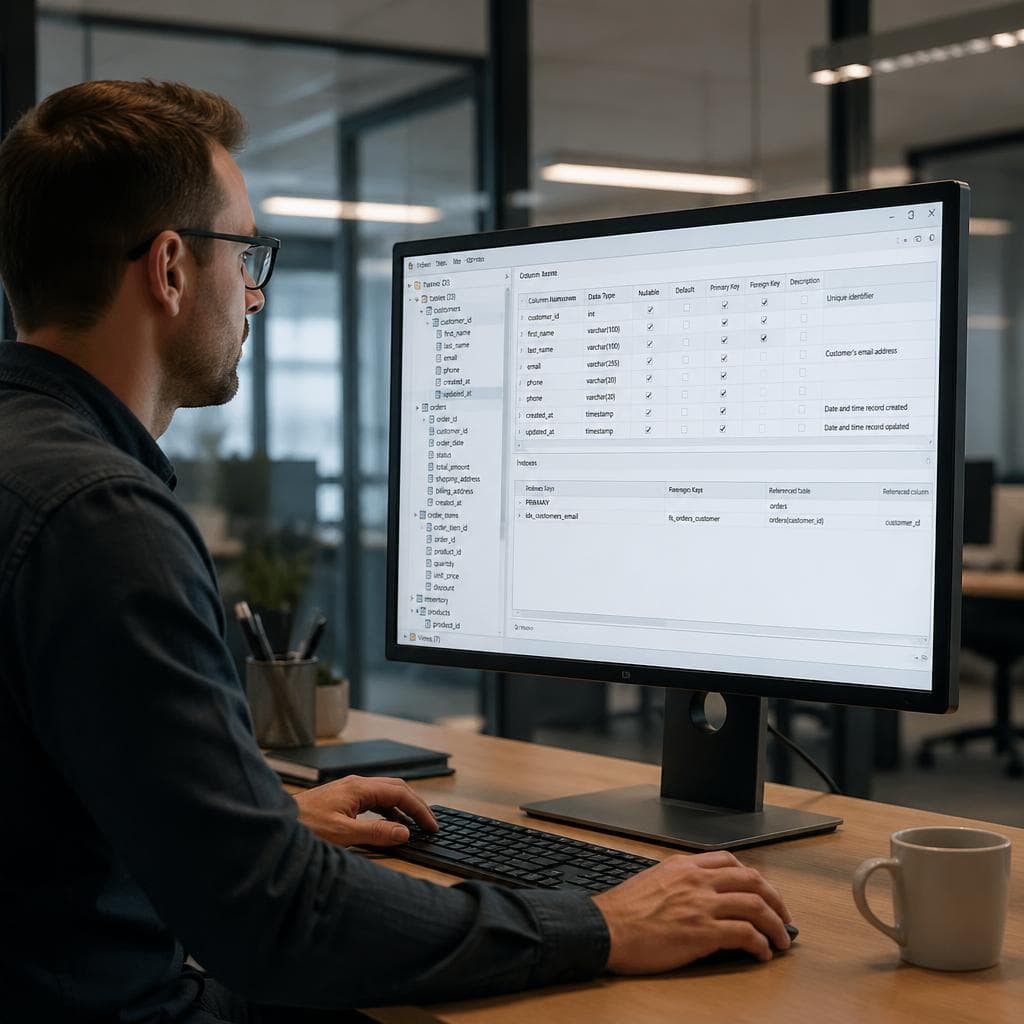
To create a Topic, navigate to the Topics section and add a new one. Select the tables from your connected database that belong to a coherent business domain. For a sales analytics Topic, you might include an orders table, a customers table, and a products table.
Within the Topic, rename fields to match the language your team uses. If your database column is named gross_margin_excl_returns, label it "Net Margin" in the Topic so that business users can query it by name. Define measures here as well: total revenue, average order value, month-over-month growth. These calculations live in the Topic and are available to everyone who queries it.
You can also specify default filters. If your orders table includes test orders that should never appear in business reporting, filter them out at the Topic level so analysts never see them regardless of how they phrase their question.
Teaching the AI About Your Business
Adding AI context is the step that determines how accurate the assistant will be in practice. Omni structures context across three levels.
At the model level, you set global rules that apply across all Topics in the workspace. A common example is specifying which revenue field is canonical when multiple tables have similarly named columns.
At the Topic level, you add domain-specific guidance. For a finance Topic, this might include rules like "always filter for completed transactions" or "when asked about this quarter, use the fiscal calendar, not the calendar year." Supplying five to ten example questions with their expected answers at this level helps the AI calibrate to your specific dataset.
At the field level, you annotate individual fields with synonyms, usage notes, and sample values. If your team calls churned customers by three different names in Slack threads and support tickets, listing all of them under the relevant field ensures the AI recognizes any variation.
Omni recommends starting with your two or three most active users, collecting their ten most common data questions, and using those to seed the initial context. Treat the AI like a new analyst: give it the business rules it would need to answer questions correctly on its first day.
Using the AI Assistant
With a Topic set up and context added, team members can use the AI assistant in two modes: standalone chat and the dashboard assistant embedded within a published dashboard.
In standalone chat, a user types a question such as "what were the top ten customers by order value in Q1 2026?" The AI generates a SQL query, runs it against the connected database, and returns the result in a table or chart. Follow-up questions update the output without any SQL editing.
The AI also generates visualizations on request. Asking "show me this as a bar chart grouped by region" updates the chart type and grouping. For more complex questions, Omni supports multi-step agentic workflows: if a user asks "why did revenue drop in February?", the AI runs a sequence of queries across dimensions, compares metrics, and returns a summary with supporting charts.
The assistant respects the context and filters you defined in the Topic. If you told Omni to use the fiscal calendar, the AI applies that rule even when the user does not mention it.
Connecting Omni to Claude Desktop
In March 2026, Omni released an MCP server that lets analysts query Omni data directly from Claude Desktop, ChatGPT, and other tools that support the Model Context Protocol. This is useful for teams who prefer to stay in a single AI environment rather than switching between tools.
To enable it, you configure the Omni MCP server with your Omni API credentials and add it to your Claude Desktop settings. Once connected, you can type a question into Claude and Claude will pull results from your Omni Topics, returning data that you can then analyze, summarize, or incorporate into reports.
This setup is optional but useful for analysts who run complex research workflows and want their warehouse data available alongside other tools without leaving their primary environment.
Publishing Dashboards for Your Team
Once you have built a set of charts or completed an analysis worth sharing, publish it as a dashboard in Omni. Dashboard viewers do not need SQL knowledge or model access. They see published charts and can use the dashboard AI assistant to ask questions scoped to the data visible to them.
Omni also supports scheduled delivery. You can configure dashboards or specific insights to be sent by email on a daily or weekly cadence. This is useful for operations leads or executives who want a regular summary without logging into the tool.
Practical Next Steps
Setting up Omni involves five steps in sequence: connect your database, build a Topic that defines your key metrics and business terms, add AI context at the model, topic, and field levels, grant team members viewer access, and publish dashboards for regular reporting. The quality of answers from the AI assistant correlates directly with the quality of context you provide upfront. A well-configured Topic with clear field definitions and example questions reduces the back-and-forth between analysts and business users significantly.
If your team does not yet have a data warehouse but wants to start with AI-powered analysis, VSLZ AI lets you skip the warehouse requirement by uploading a CSV or connecting a data source directly and getting insights from a single plain-English prompt.
FAQ
Does Omni Analytics require SQL knowledge to use?
Omni's AI assistant handles SQL generation automatically. Business users type questions in plain English and the assistant writes and runs the query against the connected database. Setting up the initial connection and building Topics typically requires someone with database admin access, but day-to-day analysis does not require any SQL knowledge.
What databases does Omni Analytics connect to?
Omni supports Snowflake, Google BigQuery, Amazon Redshift, Databricks, ClickHouse, PostgreSQL, MySQL, Microsoft SQL Server, MariaDB, Trino, and MotherDuck. Cloud warehouses like Snowflake and BigQuery use OAuth or service account authentication. PostgreSQL and MySQL use standard host-port-username-password connection credentials. SSH tunneling and private link options are available for databases not exposed to the internet.
Is Omni Analytics free?
Omni offers a free trial available on their website at omni.co. Public pricing is not listed. Teams contact sales or book a demo to get pricing based on their organization size and use case. Omni raised $69 million in funding in March 2025 and continues to expand its product capabilities.
What is an Omni Topic and why does it matter?
A Topic is a semantic model that defines which database tables, fields, and calculated metrics are available within a specific business domain. For example, a Sales Topic would include your orders, customers, and products tables, with fields renamed to match how your team talks about them. Topics control what the AI assistant can query, ensure consistent answers, and apply business rules like default filters automatically. Without a Topic, the AI has no business context and produces unreliable results.
Can Omni connect to Claude or other AI assistants?
Yes. Omni released an MCP server in March 2026 that enables connections to tools supporting the Model Context Protocol, including Claude Desktop and ChatGPT. Once configured with your Omni API credentials, you can query your Omni Topics directly from Claude Desktop without switching to the Omni interface. This is useful for analysts who run research workflows across multiple AI tools.